The Big Shift
If your organization actively utilizes your HRD Corp levy for workforce upskilling (including HCC, SBL, SLB, or FWT schemes), a major policy shift is coming that requires immediate attention.
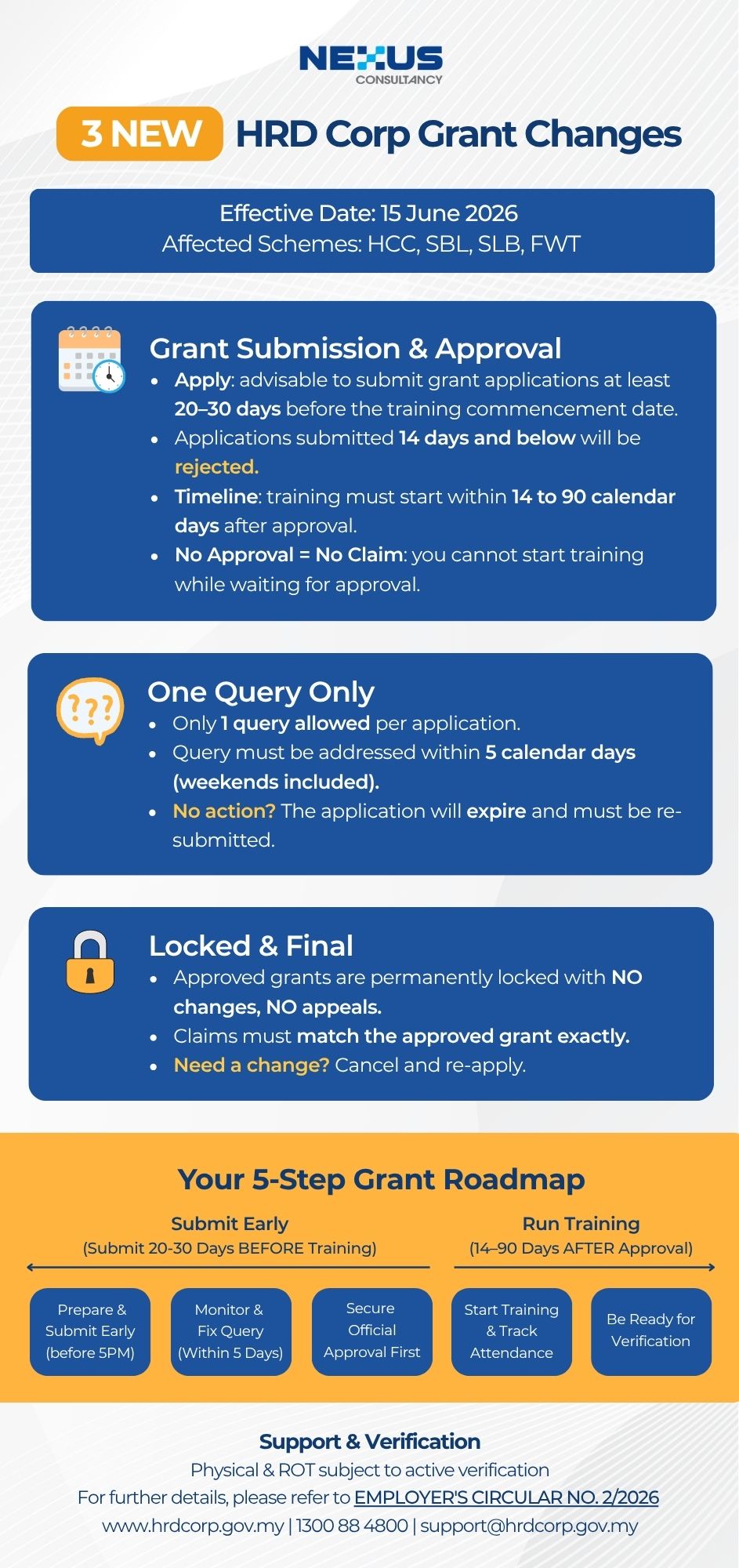
HRD Corp has officially issued Employer’s Circular No. 2/2026, introducing strict structural policy revisions that take effect on 15 June 2026. This update completely reshapes how training grants are processed, approved, and managed. Failing to comply with these new administrative boundaries will result in unclaimable training funds and automatically rejected applications.
The Compliance Visual Blueprint
To help your HR department update your internal submission timelines before the June 15th deadline, please review the 5-step operational roadmap below:
Example: How the Timeline Plays Out
Here is how the dates line up for a training start of Monday, 27 July 2026, for an in-house programme (the 14-day rule). Actual dates depend on HRD Corp’s processing, weekends and public holidays.
| Stage | Date | Note |
|---|---|---|
| Grant submitted | Fri, 3 Jul (before 5:00 PM) | Processing SLA starts the same day |
| Query raised | Mon, 6 Jul | 5-day response clock starts |
| Query response due | Fri, 10 Jul | Miss it and the application expires |
| Grant approved | Mon, 13 Jul | The 14-day wait begins |
| Earliest training start | Mon, 27 Jul | 14 calendar days after approval |
From submission to training is 24 days, which sits inside the recommended 20–30 day window.
A note on counting days: every deadline that applies to you is in calendar days, so weekends and public holidays count. These are the 5-day query response, the 14-day wait, the 14–90 day window, and the 20–30 day advice. The only thing counted in working days is HRD Corp’s own processing time, which pauses over weekends and public holidays. That is why a Friday-evening submission stalls until the following week.
Strategic Guide: How to Adjust Your Internal HR Workflow
While the visual roadmap above outlines the structural rules, your HR team needs to adjust its daily operations to handle these new bottlenecks successfully. Here is how to execute your next grant submissions under the new policy framework:
1. Plan and Submit Your Training Dates Firmly in Advance
All grant applications must be submitted at least 20 to 30 calendar days before training begins. Late submissions face automatic disqualification: the earlier you submit, the safer your funding. Remember that training can only start 14 calendar days after approval, so anything submitted too close to the training date will be rejected outright.
While HRD Corp maintains a 24-hour processing SLA, weekend gaps and data queries cause critical delays. An application filed after 5:00 PM on a Friday won’t be reviewed until Monday, pushing approval to Tuesday. To protect your levy, strategically aim to submit all applications 3 to 4 weeks before your training date.
2. Tighten Your Training Date Agreements
Ensure your external training providers lock down firm dates that fall strictly within the 14-to-90-day window post-approval. Under the new guidelines, HRD Corp strictly prohibits general grant modifications, amendments, or appeals once approved. If a training vendor needs to shift or change your scheduled dates, you cannot simply update the timeline; you must cancel the existing approved grant entirely and submit a brand-new application. Any deviation from the officially approved dates in the system will result in your final claim being rejected for non-compliance.
3. Treat Your First Draft as Final
HRD Corp is removing administrative back-and-forth by enforcing a strict “One-Query” bottleneck, giving you just 5 calendar days (weekends included) to respond before an application expires. Double-check every invoice line item, course code, and trainer profile before hitting submit. Note that while core training structures cannot be altered post-approval, HRD Corp does allow you to amend trainee details (such as names, IC numbers, or positions) later during the final claim submission stage.
Before You Submit
Training date is confirmed and at least 14 days after expected approval
Submitting 20–30 days before the training date
Submitting before 5:00 PM on a working day
Course, trainer, participants, quotation and invoice all checked
Someone assigned to watch for the query and reply within 5 days (weekends included)
Everyone knows the grant is locked once approved
Frequently Asked Questions
Q1. When can training start after the grant is approved?
A: For in-house programmes, 14 calendar days after approval, and it must commence within the 14-to-90-day window. Starting sooner than day 14 is non-compliant.
Q2. Is the rule different for public (external) courses?
A: Yes. From 15 June to 31 December 2026, public training programmes can be conducted 3 calendar days after approval instead of 14. The 90-day commencement window still applies. In-house programmes follow the 14-day rule.
Q3. How many queries will HRD Corp raise, and how long do I have?
A: One query per application. You must respond within 5 calendar days, with weekends and public holidays included. Miss it and the application expires, so you submit a new one.
Q4. Can I modify or appeal a grant after it’s approved?
A: No. Approved grants can’t be modified and appeals aren’t accepted. To change anything, cancel the grant and submit a new application. The only exception noted in the FAQ is a request to postpone training, which you should confirm directly with HRD Corp.
Q5. I submitted before 15 June 2026 but it isn’t approved yet. Which rules apply?
A: Applications submitted before 15 June that are still pending are processed under the previous terms. Existing approved grants also keep the terms in place when they were approved. Anything submitted or resubmitted on or after 15 June follows the new rules.
Q6. Is there a deadline to submit the claim?
A: Yes. Claims must be submitted within 6 months of the training completion date.
Q7. Do I need confirmed training dates when I apply?
A: Yes. HRD Corp requires confirmed dates. Tentative or provisional dates aren’t accepted, and your claim must match the approved dates exactly.
Q8. Which training is subject to verification?
A: Physically delivered training and remote online training (ROT) are subject to active verification. E-learning, coaching and mentoring, and overseas programmes are excluded.
Our Strategic Advice: Lock Your Calendars Early
To avoid a last-minute rush, expired applications, or wasted training budgets, corporate management teams must now plan training calendars earlier, verify all vendor details upfront, and submit applications well in advance.
If you have an upcoming course scheduled and want to make absolutely sure your timeline structures align safely with the new policy frameworks, our team is ready to support you.
Feel free to share your upcoming training schedule with us by dropping a message in the form below, and our consultant will be in touch shortly: